Your First Match on Television: Follow One Player Off the Ball
Follow one player off the ball during a televised soccer match to spot useful runs, passing options, and the small choices that shape each attack.
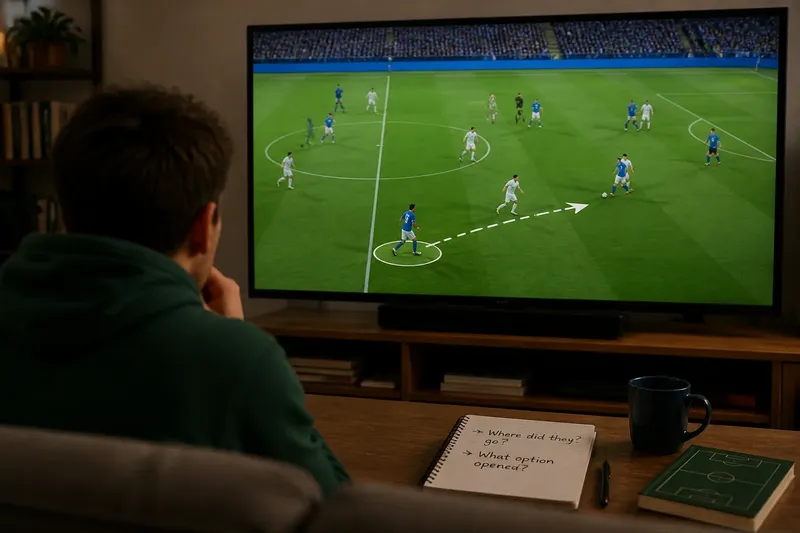
The camera follows a pass toward the wing, but the midfielder who made it has already started moving. Following one player off the ball during a televised soccer match gives you a way to see that movement—and to understand choices the ball alone doesn’t explain.
Pick one player for a short stretch, such as a central midfielder or a forward, and watch where they go when a teammate has possession. The exercise can feel slippery at first: broadcasts cut between close-ups, players disappear behind other bodies, and there is always another tempting movement to follow. Treat those moments as ordinary viewing problems, not signs that you’re doing it wrong.
Why does your player keep disappearing?
The most common snag is losing sight of the player as the camera zooms toward the ball. A television director usually prioritizes the immediate contest, so the player you chose may drift beyond the edge of the shot.
Try following a player who is near the ball’s likely next destination rather than one stationed at the far edge of the field. A wide midfielder, for example, may remain visible as play shifts toward that side. You can also choose a player in the same general part of the picture as the ball, then switch your attention back to them after each pass.
When the player vanishes, don’t guess where they went. Watch the next wide shot or replay for their position, then resume. If the broadcast stays tight, use the ball carrier as a temporary reference: notice whether your player appears as a nearby option when the camera widens.
What if you can’t tell which player you picked?
Similar kits and quick camera cuts make identification tricky, especially when several players occupy the same area. Choosing someone by role and location is often easier than trying to memorize a face.
Before settling in, identify a visual clue: perhaps a player who starts wide on the left, a forward in a contrasting hairstyle, or a midfielder who repeatedly arrives near the edge of the center circle. Keep the clue simple. A particular role and side of the field are usually more useful than several details at once.
If you lose track, wait for a wider view and re-identify the player from their starting position or teammates around them. Don’t switch targets every time a different player makes an eye-catching run; that turns the exercise back into trying to follow everything.
Why does the movement seem to go nowhere?
A player can move without receiving a pass. They might pull a marker away, open a lane for a teammate, or hold their position so a nearby player has room to advance. If you judge every movement by whether it ends with a touch, much of the useful action will look pointless.
Instead, ask a small question: did the player move into space, draw someone with them, or stay available for a return pass? Then look at what changed around them. Did a teammate find a clearer route forward? Did the defender follow, or stay put? You don’t need to know the intended plan to notice the visible result.
Say you choose a left-sided attacker who keeps making short runs toward the near post while a teammate carries the ball along the touchline. The attacker never receives a pass, but a defender follows and leaves another attacker less crowded. You can observe the movement and its likely effect without claiming to know exactly what the player intended.
How do you read the player’s options?
Once you can keep your player in view, notice what they could do next. Are they facing the ball, turning their back to it, or moving across a defender’s line of sight? Is there open grass nearby, or is a teammate already occupying that space?
Think in terms of options rather than predictions. A player might be available for a pass, making a run behind the defense, or staying close enough to help if possession is lost. The broadcast angle may hide a passing lane or a defender, so leave room for uncertainty.
A useful routine is to check the player just before a pass, during the ball’s travel, and after it reaches the next teammate. Their position may change the receiver’s choices even when the player never touches the ball. That short sequence is easier to read than trying to reconstruct the entire attack.
What can you do when the camera cuts away?
A replay can reveal a movement the live shot missed, but replays also interrupt the flow. Don’t treat every replay as a complete view of the action; the broadcaster may show the shot, tackle, or goal rather than your player’s earlier run.
Use the cut as a natural pause. When the live picture returns, locate your player again and ask whether their position has changed. If a replay happens to show them, note where they were relative to the ball and nearby opponents, then return to the live action without trying to track every detail.
It can help to keep a small note on your phone or beside the couch with just two prompts: “Where did they go?” and “What option opened?” Write down an observation only when it feels clear. The point is to sharpen attention, not to produce a complete account of the match.
What should you watch for when following one player off the ball?
Should I choose a forward or a midfielder?
Choose whichever player remains easiest to locate in the broadcast. A forward can make clear runs toward goal, while a midfielder may offer more frequent glimpses of how a team links passes; either can work.
Should I follow the same player for the whole match?
No. A short stretch is enough to practice, and changing targets at a natural pause can help if your first choice is repeatedly out of view. Keep one player at a time so the exercise stays focused.
Do I need to understand the formation first?
No, but a rough sense of the player’s position helps you find them again. Notice whether they usually begin wide, central, high up the field, or closer to their own goal.
What if I miss an important moment?
Let it go and return to your player when the picture allows. Following off-ball movement is a viewing exercise, not a demand to catch every event at once.
How can you make the exercise easier next time?
Keep the aim modest: follow one player through a few possessions, not every minute of a match. Start with a player who often appears near the ball, then try someone farther away once you’re comfortable recovering them after camera cuts.
After a stretch, give yourself one plain observation: the player stayed wide, moved closer to the ball, or ran into space without receiving it. That is enough to make the next sequence more legible. Following one player off the ball works best when you allow uncertainty, return to the picture, and notice what their movement makes possible for everyone else.