From Two Halves to Two Legs: What a Tie Means
A football tie can mean a match or a two-leg contest. Learn how halves, aggregate scores and separate fixtures shape what each result means.
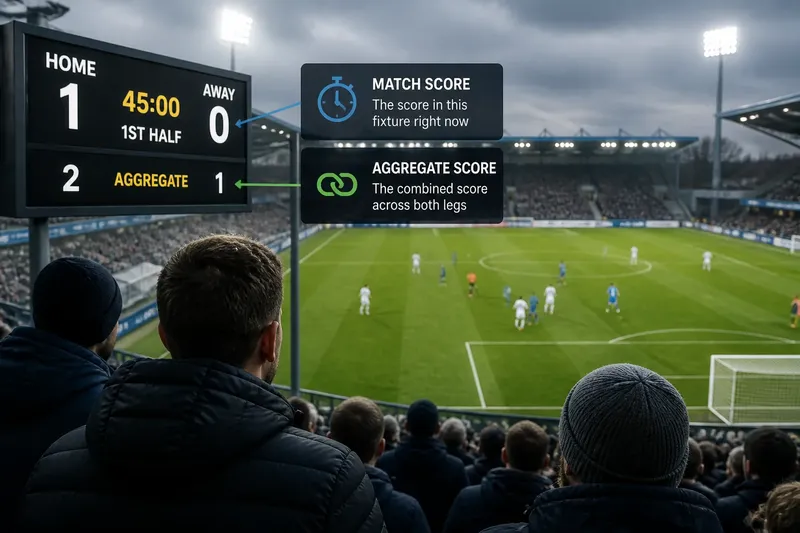
You check the score at halftime: 1–0. Then a commentator says the sides are level in the tie, and the numbers seem to disagree. In football, a match has two halves; a tie can mean that single match or a contest spread across two matches. Keeping those units separate makes the score easier to read.
What does “tie” mean in football?
The word has two common uses. In everyday match talk, “the teams are tied” means the score is level. In a knockout draw, “the tie” often means the entire contest between two teams, which may consist of one match or two legs.
Listen to the surrounding words. “A 1–1 tie” usually describes a match score, while “the first leg of the tie” identifies one fixture within a larger contest. The phrase “level on aggregate” refers to the combined score across the legs, not to the score in the current match.
This distinction matters because a match and a tie answer different questions. A match score tells you what happened in one fixture; the tie’s result tells you which team advances from the knockout contest.
How are halves different from legs?
A standard match is divided into two halves, with a break between them. Both halves happen on the same match day, in the same fixture, and contribute to one match score. A goal in either half changes that score.
A two-leg tie, by contrast, is played across separate fixtures. Each fixture has its own two halves, its own kickoff and match score. The legs are commonly called the first leg and second leg, and their scores are combined to form the aggregate score.
So a two-leg tie does not mean a match with four halves. It means two matches, each made of two halves. The first match is not a long first half, and the second is not a second half played on another day.
- Half: one timed part of a single match.
- Match: one fixture, normally containing two halves.
- Leg: one of the separate fixtures in a multi-match knockout tie.
- Aggregate: the combined goals from the legs of a tie.
How does a two-leg tie work on the scoreboard?
Imagine a made-up knockout contest. Northside wins the first leg 2–0 at home; Southside wins the second leg 1–0 away. The second match ends with Southside ahead on that match’s score, but Northside has scored three goals across the tie while Southside has scored one. Northside therefore leads on aggregate in this invented situation.
That example shows why the second-leg scoreboard alone may not tell you who is ahead overall. A broadcast may show both the live match score and an aggregate score, often in a graphic near the regular scorebug. If you see “agg” or “aggregate,” treat it as a separate running total, not another description of the current match.
In a one-match knockout tie, there is no earlier leg to add. The match itself decides the contest, subject to the competition’s rules if the score is level at the end of normal time. In a two-leg tie, the regulation-time score of each leg contributes to the combined total; what happens if that total is level is a separate matter.
Does the second leg have a different job?
Every leg is a complete match, but the teams enter it with a shared history from the first. A team that leads on aggregate may approach the next fixture differently from one that needs goals. That context can influence risk-taking, substitutions and how much space each side is willing to leave behind.
For a viewer, it helps to track two things at once: the current match score and the aggregate score. A team can be losing the second leg while still leading the tie, or winning the second leg while still trailing overall. Neither result is contradictory; they refer to different scorelines.
Say a fictional team, Harbor, loses its first leg 0–1 and scores early in the return match. If the live score reads Harbor 1–0, the teams are level on aggregate at that moment, even though Harbor is ahead in the second match. The useful question is not only “Who is winning this match?” but also “What is the combined score now?”
What changes when a tie reaches its end?
The match clock and the tie’s status are related, but they are not interchangeable. The referee’s final whistle ends the match’s normal playing time; it does not by itself explain what happens next if the knockout contest is still level. Depending on the competition, the rules may call for extra time, a penalty shootout, or another specified method.
Do not assume that every two-leg tie uses the same tiebreak. Some competitions have used away-goal rules, while others do not; procedures can also vary by competition and season. For the exact outcome, check the competition’s current regulations or the broadcast explanation rather than carrying one tournament’s rule into another.
Extra time, when provided, is played as part of the deciding match, not as an additional leg. A shootout is a way to settle advancement; its kicks do not add to the match’s goal score or the aggregate total. That is why a broadcast can show a tied match and still have one team advance after a shootout.
Which score should you watch, and when?
Use the match score to follow the action in front of you: goals, the lead in that fixture and whether the score is level. Use the aggregate score to follow the tie across both legs. At halftime, the first number has not reset, but play has paused; at the start of the second leg, the match score begins anew while the aggregate carries over.
When you hear a commentator say a team is “one goal up,” notice whether they mean in the match or in the tie. Phrases such as “in this leg” and “on aggregate” usually make the distinction clear. If the broadcast does not display the combined score, add the goals from each leg mentally, keeping the two match scores visible in your notes or on screen.
What do viewers often ask about two-leg ties?
Can a two-leg tie finish level?
Yes. The aggregate scores can be equal after both legs, and the match score in the second leg can also be level at the final whistle. What follows depends on the competition’s tiebreak rules.
Does a team play four halves in a two-leg tie?
It plays two matches, each normally divided into two halves, so there are four halves across the whole tie. The halves belong to separate fixtures, with a break between the two match days as well as the usual halftime interval.
Can a team win a leg but lose the tie?
Yes. A team can win the second match yet still finish behind on aggregate because it lost the first leg by a larger margin. The reverse can happen too: a team may lose the second leg but advance on the combined score, depending on the applicable rules.
Does halftime reset the aggregate score?
No. Halftime pauses one match; it does not erase goals already scored in that leg or the earlier leg. The match score and the aggregate remain distinct totals throughout the contest.
What is the simplest way to keep the terms straight?
Think of a half as a section of a match, and a leg as a whole match inside a larger knockout contest. A tie can name that contest, while “tied” can describe an equal score. For the next two-leg broadcast you watch, identify whether each graphic shows the current match or the aggregate; that small habit makes every update easier to place.
When you search for a football tie explained, look for those same distinctions: halves belong to matches, legs are separate matches, and aggregate combines the legs. Once you know which unit a score refers to, the commentary becomes much less mysterious.